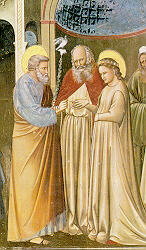


under the patronage of St Joseph and St Dominic
By the rivers of Babylon there
we sat and wept, remembering Zion;
on the poplars that grew there we hung up our harps. . . Ps 136
|
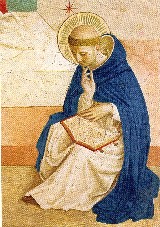
under the patronage of St Joseph and St Dominic By the rivers of Babylon there
we sat and wept, remembering Zion; |
|
|
MATER POPULI FIDELIS – MATER ECCLESIAE
When that the Immortal deigned to look On us poor folk to make us free, He chose a Maiden whom He took From Nazareth in Galilee. Since when the Islands of the Sea, The Field, the City and the Wild, Proclaim aloud triumphantly A Female Figure with a Child...[1] Download
this document as a
 PDF PDF
Is the novel title bestowed on the Blessed Virgin by Pope Leo XIV last month, Mater Populi fidelis, distinguishable from that introduced by Paul VI sixty-one years ago (almost to the day), Mater Ecclesiae?
Mater Ecclesiae The title Paul VI proclaimed of Our Blessed Lady on November 21st, 1964, ‘Mother of the Church’, must be seen in the light of his first, and programmatic, encyclical Ecclesiam Suam (August 6th, 1964). A study of the encyclical exposes the title as misleading. Its focus was not the Church Jesus Christ had founded. It was not (to translate the Latin title into English) His Church, but a surrogate, an invention of the Pope along Modernist lines.
In Ecclesiam Suam’s first paragraph we read this: “Jesus Christ founded His Church to be the… mother of all men”. Christ did no such thing! The statement neglected essential distinction, was offensive to pious ears and savoured of heresy.[2] Then, in n. 6 he said: [I]it is not our intention to express ideas that are either new or fully developed; the ecumenical council exists for that purpose…” Since any council, especially an ecumenical, or general council of the Catholic Church, relies for its integrity on the Pope’s endorsement, his deference to the allegedly ecumenical council then in progress betrayed Catholic truth – that its authority depended on his authority - and contradicted teaching of the Vatican Council in its Dogmatic Constitution Pastor Aeternus (July 18th, 1870), that— “[t]he Holy Spirit was not promised to the successors of Peter that by His revelation they might disclose new doctrine, but that by his help they might guard sacredly the revelation transmitted through the apostles and the deposit of faith, and faithfully set it forth.” [Dz. 1836][3] Hence, three months prior to his proclamation of this novel title for the Blessed Virgin, Paul VI showed that his understanding of Christ’s Church was dysfunctional. There was more to come.
On November 21st, 1964, just prior to his proclamation, he compounded what he had essayed in Ecclesiam Suam by endorsing the attempt by the ersatz ‘Second Vatican Council’ in its document Lumen Gentium, to depart from the teaching the Catholic Church had expressed in 1870. Bear in mind in what follows that by his endorsement Paul VI made that flawed Council’s flawed document his own.
In the very first paragraph of Lumen Gentium we find this statement— “By her relationship with Christ, the Church is a kind of sacrament or sign of intimate union with God, and of the unity of all mankind.” Here the ‘Council’s’ bishops endorsed Paul VI’s misunderstanding of the nature of the Catholic Church and compounded it with an error of their own.
Since Christ did not found His Church to be ‘a kind of sacrament’, nor for it to be a means of ‘the unity of all mankind’, the ‘Church’ to which the bishops referred could not possibly have been the Catholic Church. This did not inhibit them from identifying this flawed entity with Christ’s Church. They proceeded to elaborate their thesis with this further novelty: “This… unique Church of Christ… subsists in the Catholic Church… although many elements of sanctification… can be found outside her visible structure…” (Lumen Gentium n. 8) As innumerable entries in the Epistles of St Paul, the teachings of the Church’s Fathers and of her theologians and Popes attest, it is impossible that the entity they referred to could have been the Catholic Church. Hence, ‘the Church’ of which Paul VI proclaimed Our Blessed Lady to be ‘the Mother’ at the closing of the third session of this ‘Council’ was not the Catholic Church. It was the novel entity he had conceived, brought to fulfilment by the bishops of the ersatz Council.
This human invention, a counterfeit, Paul VI referred to as ‘the Conciliar Church’. His successor called it ‘the Church of the New Advent. We know it as the Church of Vatican II.
Established today in the Vatican, this counterfeit masquerades as the Catholic Church. Through ministers infected with the Modernist virus – including, as has become obvious, Pope Leo XIV - the thing dominates the offices and proper operations of Christ’s Church, subverting them to diabolical ends, the chief of which is to lead the Catholic faithful, by degrees to loss of faith and atheism as Pius X had forecast in Pascendi Dominici Gregis (September 8th, 1907).
Note It will be asserted that the title ‘Mother of the Church’ has been adopted universally among the Catholic faithful and cannot now be impugned. Paul VI included the title in the Litany of Loreto and it is repeated by the faithful whenever they recite the Litany. It will be asserted, also, that the address had appeared previously in the history of the Catholic Church in the writings of St Ambrose and in an encyclical of Leo XIII. Yet for 1,900 years the Catholic Church had refrained from adopting it. She had refrained for the very good reason that the title conflicts with long established titles the Church has accorded Our Blessed Lady, as it conflicts with her teaching, grounded in St Paul’s Epistle to the Ephesians that, as a husband is the head of his wife, Christ is the Head of the Church, and as Christ gave His life for the Church a husband ought to sacrifice his life for his wife. It conflicts with the Church’s teaching that the Church is Christ’s spotless Bride. She is not, as it were, His sister! It conflicts, too, with the Church’s teaching that Our Blessed Lady is a form, or model, to which she is to conform herself. It conflicts with the teaching that the Church is the Mother of all the faithful. It is surely no accident that in his clumsy attempts to reinterpret sacred scripture along heterodox lines - as in the Apostolic Letter Mulieris Dignitatem (August 15th, 1988) - Paul VI’s successor, John Paul II, did his best to emasculate this teaching of St Paul.
Mater Populi Fidelis Sixty years on and another Pope wants to bestow another novel title on Our Blessed Lady, Mater Populi Fidelis. In the eponymous ‘doctrinal note’ (November 4th, 2025), the Congregation for the Doctrine of the Faith sought to substitute this novelty for legitimate titles the Catholic Church has long accorded her, Co-Redemptrix and Mediatrix of all Graces. Pope Leo XIV’s endorsement of the document, as with its endorsement of the defective Council on which it relies, confirms his Modernism.
The attitude betrayed in the ‘note’ suits the Modernist thesis that it is an error to assert that Christ died to repay the infinite debt committed by men in sinning against God. There was no question of Divine Justice; Christ died merely to show God’s love for us, they assert. The claim makes no sense, for why else would He have undergone so frightful a death. Yet its illogicality founds a logical conclusion which helps the Modernist cause. If Christ was not our Redeemer, there was no need for a Co-Redemptrix.
The attitude suits another Modernist fetish – ecumenism. Let us first note that the word ‘ecumenism’ has a noble etymology, its source the Greek oikoumenē deriving from oikos, ‘house’ and the verb oikein, ‘to inhabit’. It signifies ‘the household’. An ecumenical council looks to the household of the Church and its welfare.[4] Consistent with their modus operandi, Modernists hijacked the word in the early 20th century and gave it a pejorative meaning according parity to other religions. Ecumenism, as proposed by the Modernists, reduced the divine and Catholic faith ordained by Almighty God to no more than parity with any merely human faith.
With widespread adoption of this falsity, ecumenism was now regarded as a principle, and the titles Co-Redemptrix and Mediatrix of all graces were seen as betraying that principle. How, it was asked, could endorsement of the titles be the will of the Holy Spirit? A further aspect of the Modernist thesis buttressed this position, its assertion of the evolution of doctrine. One need not be concerned that the Church had previously addressed Our Blessed Lady with these titles, the Modernists argue. Things have changed in the Church; we must move on!
The constant teaching of the Catholic Church has ever been that no one can enter heaven unless a member of the Church. The Modernist solution to the problem this posed was to enlarge what is meant by ‘membership of the Church’. This is behind the ersatz Council’s claim, already mentioned, that— “many elements of sanctification can be found outside [the Church’s] visible structure” (Lumen Gentium n. 8; cited by John Paul II in Ut Unum Sint, May 25th,1995). Thus, with Vatican II, Church membership was extended to those the Church had previously excluded, identified now as “God’s faithful people”. Let the reader observe how Leo’s novel title, “Mother of the Faithful People”, serves this preconception.
The Catholic Church & the Church of Vatican II The doctrinal note’s denigration of Our Blessed Lady’s legitimate titles reflects Modernism’s alliance with Protestantism the signal characteristic of whose heterodoxy is antipathy to Christ’s Mother. How did this occur? Luther’s theological error, rejection of God’s authority in favour of his own (a mantra parroted by each of his Protestant successors), produced in due course a condign philosophical error with two limbs— · rejection of reality’s authority in favour of the thinker’s authority – subjectivism; · rejection of the formal in reality (the influence which determines the quiddity of each element in the immense variety in creation) in favour of the merely material – materialism.[5] This twofold philosophical error developed with the so-called ‘Enlightenment’ into a denial that there could be anything transcendent in religion. This is Modernism.
Since Leo XIV’s ‘doctrinal note’ betrayed her constant teaching, it is clear that it was not a document of the Catholic Church. That it was a document of her counterfeit, the Church of Vatican II, is patent not only in the heterodoxy of its text, but in the vast majority of the authorities it cites. There are one hundred and ninety-seven footnotes of which 106 refer to the ersatz Council, while 27 rely on utterances of the one who assumed the functions, if not the office, of Pope Benedict XVI - ‘Pope Francis’.
Let the reader recall that the bishops who invented the Church of Vatican II (thinking that they were reinventing the Catholic Church), dubbed the novel entity— “a kind of sacrament or sign of intimate union with God, and of the unity of all mankind.” (Lumen Gentium n. 1) They filled out this claim with the following— “Believers and unbelievers agree almost unanimously that all things on earth should be ordained to man as their centre and summit.” (Gaudium et Spes n. 12) The very terms they employed show it is quite impossible that the entity to which they were referring was the Catholic Church.
It follows that when Leo XIV endorsed the ‘doctrinal note’ on November 4th, 2025, he acted not as Pope, but as head of the Church of Vatican II. No Catholic is obliged to obey a Pope who teaches error and this appalling document can safely be ignored.
The Blessed Virgin and the Heresies It is, in a sense, necessary that these heresies and their adherents attack the honour of the Blessed Virgin for she is their nemesis as she is the devil’s nemesis.
For more than a millennium Holy Mother Church has prayed the following words in her Divine Office and in the Votive Mass of the Blessed Virgin Mary (Tract after Septuagesima from the Common of the Blessed Virgin Mary): “Rejoice, O Virgin Mary, for thou alone hast destroyed all heresies in the whole world. Thou didst believe the word of the Archangel Gabriel. A virgin still, thou didst bring forth the God-man; thou didst bear a Child, O Virgin, and remained a Virgin still. Mother of God, intercede for us.“
Michael Baker December 8th, 2025—Feast of the Immaculate Conception ___________________________________
[1] Hilaire Belloc, Ballade of Illegal Ornaments. It is worth studying the whole of this poem for its mockery of the position of the appalling Anglican ‘Bishop’ Barnes of Birmingham, who denied the revelations of the Trinity, the Virgin Birth and the bodily Resurrection of Christ. [2] The distinction is that between act and potency: when a man speaks he is understood to speak of things as they are, not as they have might been. Here, too, is the root of the error imported into the text of consecration in his novus ordo. [4] Thus, the science addressing the return of separated brethren to the Catholic household is ‘ecumenical theology’. [5] Whose practical effect was to ruin man’s already problematic ability to think straight!
|