

under the patronage of St Joseph
and St Dominic
By the rivers of Babylon there
we sat and wept, remembering Zion;
on the poplars that grew there we hung up our harps. . . Ps 136
|
under the patronage of St Joseph
and St Dominic
By the rivers of Babylon there
we sat and wept, remembering Zion; |
|
|
|
WHEN THE WATTLE TURNS TO GOLD
This paper was written back in 2010. Its reappearance may serve to mark the 50th anniversary of the death of James McAuley last Wednesday week, October 15th, Feast of St Teresa. James wrote the words to the hymn 'Help of Christians, guard this land...' among others. Of your charity, please remember his soul in your prayers. more A HERETIC BISHOP LACKS EPISCOPAL POWERThis article was originally published on July 25th. This new rendition addresses an argument that the Pope's supreme power permits him to refuse compliance with any provision of the Code of Canon Law. more THE JEWS AND THE CHURCH OF JESUS CHRISTWhat truth is there in the assertion that the Jews are responsible for the harm that afflicts Christ's Church? more HILDEGARD OF BINGEN: A RELIABLE AUTHORITY?The short answer to the question in the title is 'No!' This paper is a response to a piece offered recently on the rorate caeli website. more THE SCHISM EXISTS ONLY IN VATICAN MINDSPhilosophy insists on a distinction between what exists in the real, real being, and what exists only in the mind, mental being. Failure to attend to this distinction is behind the dysfunction in the Vatican. more THE ALLEGED EXCOMMUNICATIONSThe issue for the Catholic faithful following the consecrations in Econe on July 1st, was whether Pope Leo would demonstrate himself to be a wise Modernist, or a foolish Modernist. Res ipsa loquitur: he has revealed himself as a foolish Modernist. What on earth does he think will be the likely reaction of the faithful generally to his 'excommunicating' those who attend the Society's priests? He is supposed to be the Pastor of Christ's sheep! His action will only serve to move the faithful generally to distant themselves from so irresponsible a shepherd. more AT LAST, A CATHOLIC DOCUMENTWe have waited for sixty years for a document setting out Catholic principle. more BISHOP SCHNEIDER'S ADVICE TO POPE LEOThis is our final paper addressing the Church of Vatican II and the Catholic Church before Bishops Fellay and de Galarreta consecrate four priests of the Society of St Pius X as additional bishops to enable the Society to continue to ordain priests free of the Modernist imposture. more THE PROBLEMS WITH ECCLESIA DEIBack in 1988 Pope John Paul II made a mess of his reaction to
Archbishop Lefebvre's initiative of consecrating bishops without a
mandate to circumvent the modernist incubus of the 'Second Vatican
Council'. We explore here the numerous errors, theological,
juridical and logical, in his Apostolic Letter, Ecclesia Dei. It
will be interesting to see how his successor, Leo XIV, attempts to
justify his own 'excommunications' of the principals, and perhaps
the priests and faithful also, of the Society founded to counter
the modernist imposition of which he, Papa Prevost, is the latest
exponent. Will Leo repeat the various errors in which John Paul
indulged? We must wait and see. more THE CATHOLIC DILEMMA & HOW TO SOLVE ITPope Leo XIV presents, daily, an immense dilemma for the Catholic faithful. Vicar of Christ, yet a modernist heretic! How is the dilemma to be solved? more WHAT MIGHT HAVE BEEN - Thoughts on Roberto de Mattei's A Cardinal For The AgesWe will leave it to others to review Italian historian, Roberto de Mattei's splendid new biography of St Pius X's Secretary of State, Cardinal Rafael Merry del Val. Our study concerns itself with his salutary influence within the Catholic Church in the 45 years from 1885 to 1930. It is too little to remark of his extensive labours for the Church and the Catholic faith against attack that he had a hand in drafting three crucial papal documents: Leo XIII's Apostolicae Curae, Pius X's Pascendi Dominici Gregis and Pius XI's Mortalium Animos. Merry del Val anticipated the incursion of Protestant, Modernist and Masonic ideas into the Church's theology, as of their sympathisers into her household. With the practical assistance he gave Pius X as Secretary of State, he aided the great pontiff's preparation for the frightful struggles to come. On the death of Pius X he continued his salutary efforts against antipathetic prelates within the Curia as head of the Holy Office, under Benedict XV and Pius XI, until his precipitate death on the operating table. The reader may despair of finding a bishop in the current episcopacy who can truly be labelled 'Catholic' - apart from the two in the Society of St Pius X (who lack any jurisdiction) and the allegedly excommunicated Archbishop Carlo-Maria Vigano, whose jurisdiction has long since lapsed. Those of the Church's 5,500 bishops who are not fully progressive Modernists demonstrate in words and conduct their willingness to compromise with the heretics, which reveals them as not (as they like to think) Catholics, but conservative Modernists. The reader who considers the situation impossible of resolution for Christ's Church might care to study the history of the forces of Gideon against the Midianites in the Book of Judges. There, to counter a force numbering 130,000 odd, the Almighty reduced His forces from 32,000 to a mere 300. Opposition numbers mean nothing to the Almighty! more MATER POPULI FIDELIS - THE ATTACK ON THE MOTHER OF GOD
|
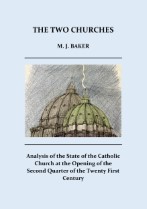
THE TWO CHURCHES - an EbookThis is a collection of papers addressing the validity of the Second Vatican Council, the propriety of the actions of John XXIII and Paul VI in promoting it, of John Paul II and Benedict XVI in supporting it, and the unintended effect of their efforts, creation of a counterfeit Church at war with the Church established by Our Lord Jesus Christ. It addresses the validity of Pope Benedict's resignation and of Jorge Mario Bergoglio's election as his successor. It closes with a suggestion as to how the Catholic faithful are to resolve the dilemma presented by the behaviour of the new Pope Leo XIV. more |
|
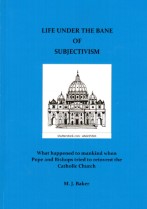
LIFE UNDER THE BANE OF SUBJECTIVISM - an EbookThis is a conflation in one paper of three separate papers originally produced in 2010, revised in 2019 and again in 2024. more The book is also available in paperback from Cardinal
Newman Faith Resources for $15.50 plus postage (if
applicable), see https://cardinal-newman-aus.myshopify.com/collections/books-1/products/baker-life-under-the-bane-of-subjectivism |
 |
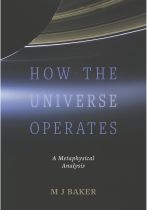
This is a remarkable little book arguing for a new way to look at
the causes involved in the natural world. I say “new“ but in
fact, it is also old, as it draws on the wisdom in the perennial
philosophy of Aristotle and St. Thomas Aquinas. However, it is
not an archaic attempt at bringing back the geocentric universe
and the four elements. Rather, it combines the enduring
principles of Thomistic philosophy with the insights and
observations of contemporary science. Specifically, it proposes
that we return to the ancient idea of an interstellar and
intermolecular quasi-substance, what used to be called “aether,”
in order to make better sense of some ideas in modern science and
to revive the relevance of instrumental, agent, causality
something largely neglected by the attention to force as an
abstract quantity. Baker does a nice job, pressing this idea, and
even takes it in directions not quite imagined by Aquinas or
Aristotle. I’m not convinced by everything he says, but the
fundamentals seem deeply right. The argument of the book should
be taken seriously.
____________________________
Christopher A Decaen B.A., M.A. Philosophy, Ph. D., Tutor, Thomas
Aquinas College, Santa Paula CA.
Michael Baker’s book ‘How the Universe Operates’ is not a long book. But it is packed with interesting and even fascinating ideas about the nature of the physical universe and our knowledge of how it operates…
There is much… in the Natural Philosophy/Science that has come down to us from the ancient Greeks, which is still full of deep insights that unfortunately the modern mind decided ought to be thrown out...
The author… has a good grasp of how precious was what we discarded in the rush to have fresh water for our modern scientific endeavours. It is good to have clean water... Pity about the fledgling baby.
What is most interesting about the book is how the author endeavours, and, in my opinion, succeeds to a significant degree, to put the “unclean” baby, which is how the Aristotelian philosophy of nature is still regarded, into fresh water… our view of modern science.
…
[W]ith my limited knowledge of modern physics (which is more a mathematical physics than what Aristotle regarded as physics) I would not venture as far as he does with such exotic notions as aether, light and gravity. But these are concepts that even the most expert of modern scientists struggle with, let alone with having to accommodate quite sophisticated Aristotelian notions of them.
There is one part of the book, where the author discusses the ancient belief that the earth was the centre of the whole physical universe, and provides an insight that I have not found elsewhere. That alone I consider makes the book worth buying if only to share that insight.
I believe that both the reader who has had a good education in modern science, even though unacquainted with ancient natural philosophy, and one who has some such acquaintance, will find much instruction and even enjoyment in reading this book.
_________________
Donald G Boland Ll. B., Ph. D., is a former lecturer at Sydney’s Aquinas Academy now retired. He is the author of a number of books on the philosophy of Aristotle and St Thomas Aquinas including Thomas of the Creator. He resides in Wagga Wagga, New South Wales.
LAUNCH OF BOOK 'HOW THE UNIVERSE OPERATES'How the Universe Operates was launched by UK publishers Austin
Macauley on December 8th 2023.
A link to the publisher’s website is here.
The
book is featured on Amazon here. It may be purchased
either in Kindle or paperback editions at good
booksellers or via amazon.com or amazon.com.au . It is
also available at Cardinal Newman Faith Resources for
$24.95 plus postage (if applicable), see https://cardinal-newman-aus.myshopify.com/products/baker-how-the-universe-operates?_pos=1&_sid=6cda1d18e&_ss=r
The address for Cardinal Newman Faith Resources is 15-21 Collins St, St Marys, NSW 2760. Telephone: 02 96732235 |
 |
We publish here a further extract from historian Henry Sire’s Phoenix from the Ashes (Kettering OH, Angelico Press, 2015, pp. 93-100) to aid the Catholic faithful in their defence of the faith against the Protestant and atheistic impositions.
Galileo was a man who, in today’s argot, we would describe as possessed of attitude, i.e., truculence or pig-headedness. He was a good scientist but had a higher opinion of himself and his views than reality allowed. He was also dishonest. Had it not been discovered, long after the events that saw him marginalised by the Catholic Church, that his opinion was close to the truth uncovered by Sir Isaac Newton 55 years later, and that his condemnation could conveniently be used as a stick with which to beat the Church, his intemperateness might have attracted the obloquy it deserved. Sire identifies the issues in this way: “A clash between impudent folly and pompous autocracy has… been misrepresented as a conflict between science and religion... The use made of it to allege an opposition between the Church and science is significant in itself, because it is the only incident in the Church’s history capable of being so presented.”
The atheists of the French Revolution sent the father of modern chemistry, Antoine Lavoisier, to the guillotine. Though this treatment of the scientist was much worse than that attributed to the Catholic Church over Galileo, never a word is published by moderns condemning atheism or its exponents. moreDr Chris Decaen of Thomas Aquinas College has a splendid article on the topic on the College's website here:
https://www.thomasaquinas.edu/news/dr-chris-decaen-lecture-galileo-church
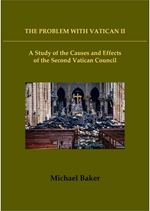
THE PROBLEM WITH VATICAN IIThis is a book length pdf file comprised of various papers published on superflumina on the vexed topic of the Second Vatican Council. The reader can download it freely. He can navigate via the Index to any of its chapters. He can have his computer read the text aloud while he labours at some task in the house, or as he drives the car. It is hoped to produce it in several additional ebook formats in due course.This is a revised and shortened version of the original publication. more |
 |
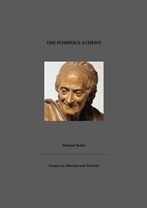
THE POMPOUS ATHEISTThis ebook addresses the endemic modern problem of atheism—belief in no-God. Atheists assert that they are above superstition, the ‘superstition’ of religious belief, but it is not true. Not only are they believers, they are believers without the slightest evidence of that in which they believe. They are the real exponents of ‘religious liberty’ for they insist on the freedom to believe there is no God. Their every action involves acceptance of causation. But, obsessed with an idea, they choose to deny causations’s reality when it comes to their own essence and existence. In this series of essays we have endeavoured to make it plain just how stupid is the atheistic thesis.It is reasonable to believe in God, no matter how confused one’s belief may be. The fundamental issues are these: 1. I did not bring myself into existence; 2. I do not keep myself in existence; 3. in this world of reality I am one of the privileged beings for not only do I know singular things, like brute animals, but I know their very natures; 4. nothing exists without an adequate cause—and that includes me! Moreover, 5. the one who caused me must be living and intellectual, as I am living and intellectual—but an immensely greater being. It is hoped that the presentation of these essays will assist the reader in resisting the temptation to embrace the atheistic virus. more |
 |
See the complete set of lessons here